
 By
By
You Don't Have a Traffic Problem. You Have an Upsell Problem.
Most owners hit a flat month and reach for the same lever: spend more on ads. More traffic, more leads, more chances to close a sale. It feels like the obvious move — more people in the door has to mean more revenue out the other side.
Except it usually doesn't work like that. If your website or your storefront already has a leak in it — people showing up, buying once, and never spending another dollar with you — pouring more traffic at it just means you're funding a bigger leak. You're not fixing the problem. You're feeding it.
Here's the more useful question, and it's the one this article is actually about:
before you spend a single extra dollar on acquisition, have you actually gotten everything you can out of the customers you already have?
For most owner-operated businesses, the honest answer is no. Not because they're bad at business — because nobody ever showed them this lever exists, or they assumed it required a whole new marketing department to pull.
It doesn't. Here's what it actually takes.
New Customers Cost You Money. Existing Ones Are (Mostly) Free.
Every new customer costs something to get in the door — an ad, a referral fee, a discount code, your own time chasing the lead. That cost is baked in before they've spent a single dollar with you.
An existing customer is different. They already trust you enough to have bought once. Getting them to buy a second, related thing costs you almost nothing extra — no new ad, no new lead gen, just a well-timed offer.
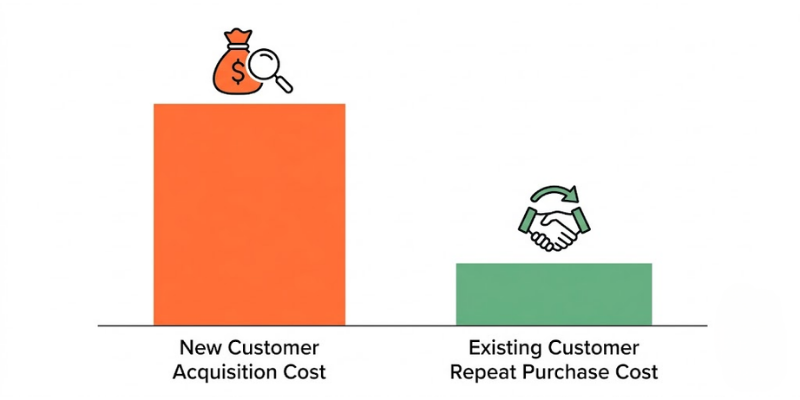 This is the whole logic behind increasing revenue without new ad spend: you're not trying to find more people. You're trying to get more value out of the people you've already paid to find.
Bundling, Not Discounting
When owners do try to sell more to existing customers, the first instinct is usually a discount. "Buy two, get 10% off." It works, sort of — but a discount trains customers to wait for the next discount, and it eats straight into your margin every single time you run it.
A bundle does something different. Instead of saying "pay less for the same thing," it says "get more for a little more." Same psychological trigger — people like a deal — but instead of shrinking your margin, you're growing the order.
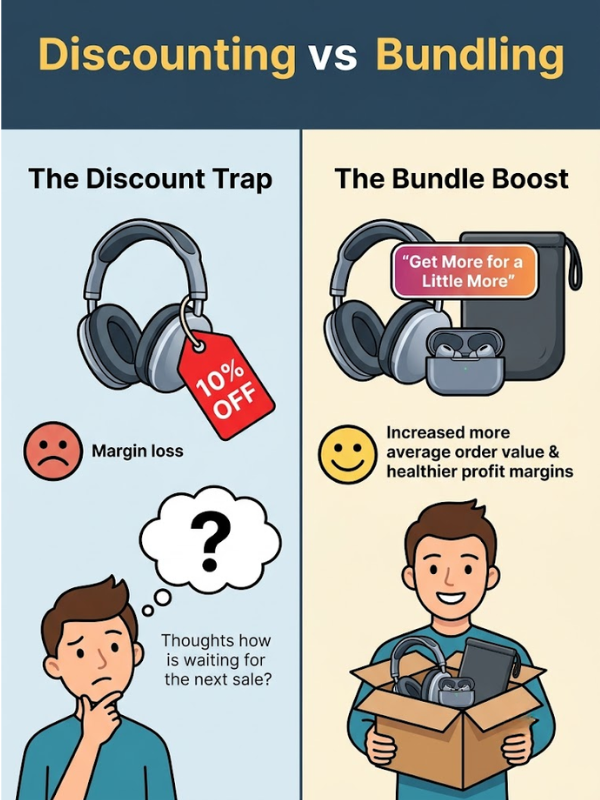
The starting point is simple: look at what your customers already tend to buy close together, even informally.
Most businesses don't have to invent this pattern — it's already sitting in their last 20 or 30 orders, just never packaged as one offer.
Timing Beats the Offer Itself
A lot of owners try one upsell, get ignored, and conclude "that doesn't work for my business". Usually what actually happened isn't that the offer was wrong — it's that the timing was.
Nobody wants an upgrade shoved at them while they're still deciding whether to buy at all. That's mid-decision, and it just adds friction. The moment right after someone says yes is completely different — they've already committed, they're feeling good about the decision, and a genuinely relevant add-on doesn't feel like a push. It feels like you're finishing what you started selling them, not squeezing them for more.
If you've tried this once and it didn't land, that's not proof it doesn't work for your business. It's proof that one specific attempt — that product, that moment, that price — didn't land. Worth trying again with the timing moved, before writing off the whole idea.
Diagnose the Actual Lever Before You Pull One
Not every flat-revenue month has the same cause, and guessing at the fix wastes time. Broadly, there are three levers that move revenue:
-
Traffic — how many people see the offer at all
-
Average order value — how much each customer spends per transaction
-
Retention — how often existing customers come back
Most owners default to pulling the traffic lever every time, regardless of which one is actually broken. If your traffic is fine but your average order value is flat, no amount of extra ad spend fixes that — you need a better offer at the point of sale, not more eyeballs on the same offer.
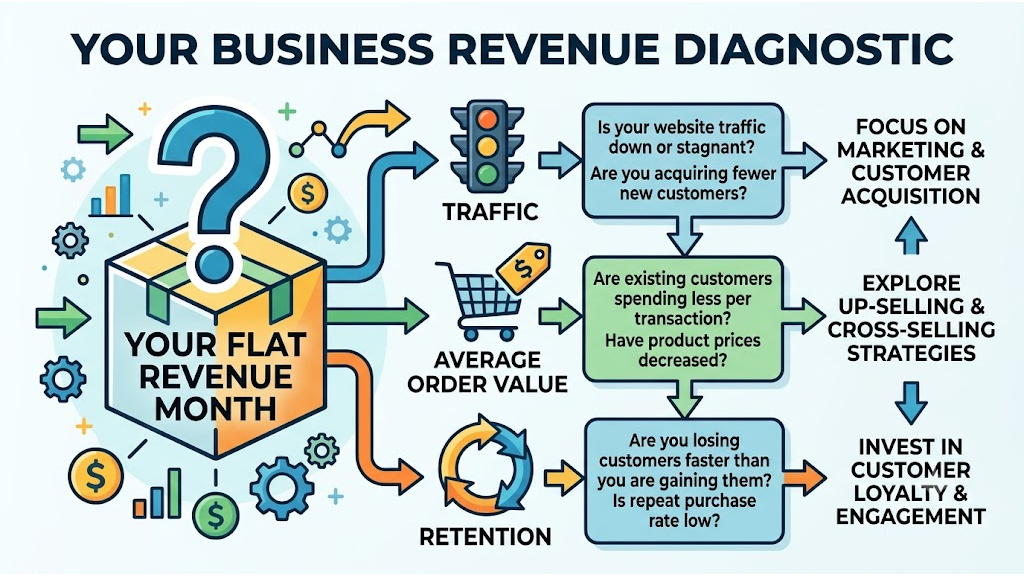
Before spending more on acquisition, it's worth a genuinely honest look at your own numbers: is this actually a traffic problem, or is it an order-value or retention problem wearing a traffic problem's clothes?
This Doesn't Require a New System
The instinct here is to assume fixing this means adopting new software, building an automated funnel, or hiring someone to run it. It doesn't have to.
The whole thing can start as one sentence, said consistently, at one point in a process you already run: "Most people who get this also grab [X] — want me to add it?"
Said at the right moment — right after a yes, not before — that single sentence is the entire mechanism.
No new system, no new tool, no new hire.
Where This Actually Leads
None of this is a secret. Bundling, timing, and diagnosing the right lever are all things most owners already half-know — they've just never sat down and actually looked at their own numbers to apply it properly.
That's the exact gap the Revenue Pathfinder Call is built to close. It's a straight, no-pitch diagnostic through your own last 90 days — not general advice, your actual numbers — to find the one thing already working in your business that's worth pointing more energy at, before anyone talks about spending another cent on ads.
If any of this sounds like it applies to your business, that's worth 45 minutes to actually find out.
FAQ
Is this just a fancy word for upselling?
Partly, yes — but the point isn't the vocabulary, it's the sequencing. Bundle and time it right, and it stops feeling like upselling and starts feeling like you finished the sale properly the first time.
Do I need new software or a CRM overhaul to do this?
No. The core version of this is one sentence, said consistently, at one point in a process you already run. Software can help you scale it later, but it's not required to start.
Will this annoy customers who already spent enough?
Only if the offer is irrelevant or badly timed. A genuinely useful add-on, offered right after someone's already said yes, tends to read as helpful — not pushy.
What if I already tried something like this and it didn't work?
One attempt is a test, not a verdict. Most failed first attempts come down to timing or offer-fit, not the underlying idea being wrong for your business.